Redefining Elegance
From the Collection
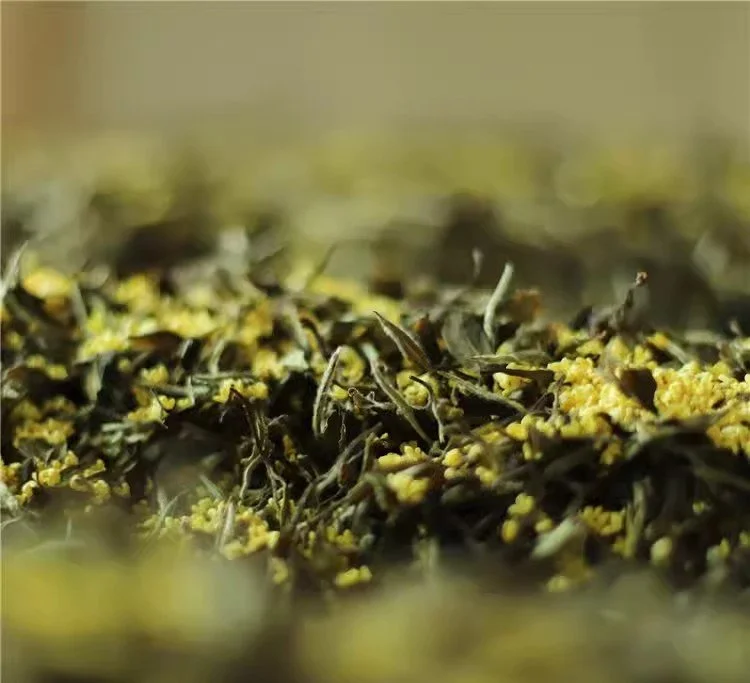
Fresh osmanthus (gui hua) scented into five very different teas. The flowers are late-blooming wild mountain osmanthus from Xianning, Hubei, known as China's "home of osmanthus" and the tea maker's hometown. They are picked in the eighth lunar month, mostly silver osmanthus with a little golden osmanthus. Everything is made entirely by hand with pure fresh flowers, using the traditional cold-scenting method, and every tea contains leaves together with dried flowers. The teas are scented in Xianning and packed by a licensed facility in Sichuan.
On osmanthus varieties (the tea maker's notes): silver osmanthus has a fresh, airy, ethereal fragrance. At first the finished tea isn't strongly scented, but the freshness is superb. Over time the fragrance grows richer while staying fresh. Golden osmanthus is immediately appealing, deep yellow, rich and sweet, but it has a subtle "heaviness" that turns and settles mid-palate. Silver is purer and keeps rising, penetrating and far-reaching. His preference is mostly silver with a little golden to lift the aroma. (These notes apply to Xianning mountain osmanthus and this method only.)
Osmanthus Lishan Oolong (2025)
The base is a 2025 spring Lishan high-mountain oolong from Taiwan: a high-grade Fushou Lishan in the light, fragrant style. Since its development in 2019 this tea has been a perennial favorite and is always in short supply. Lishan is a tightly rolled ball-shaped tea, which makes it very hard to scent. After two to three years of experimenting, the tea maker developed his process: "big-pile infusion, fine small-sieve finishing, sieving out flowers midway, and multiple scentings." Silver osmanthus brings freshness and golden osmanthus adds sweet depth. From detailed yearly records, he settled the right number of scentings and the tea-to-flower ratio around 2021.
Liquor (Nov 2025): mellow, fresh and brisk, clear, sweet and fine, full-bodied and long-lasting, and a near-perfect match for the osmanthus. It leaves a cool feeling around the teeth and a mouthful of floral fragrance.
Brewing: one 5g sachet (tea and flowers) in a 150ml gaiwan at 95°C (203°F), 5–10 seconds per steep. Drain fully each time.
Packing: 50g tin of 10 × 5g sachets. 100g = two tins; 500g = ten tins. Store refrigerated or frozen, away from light.
"Qiu Xian" (Autumn Leisure) Osmanthus Charcoal-Roasted Oolong (2025)
The base is a 2025 spring wild-grown large-leaf oolong from Anxi, charcoal-roasted. Fresh, light teas usually suit scenting better, but the warmth and depth of a traditional roasted tea, sweetened by the flowers, is a lovely choice for those who run cold or love oxidized teas. Blending floral notes into a strong, roasted tea is technically very demanding. It took excellent osmanthus and round after round of careful scenting to unite the fresh, sweet flower with the warm, mellow tea. "When people are at leisure, the osmanthus falls."
Liquor (Nov 2025): fresh osmanthus mixed with the oolong's roasted note (like barley tea) and a powdery fragrance. The liquor is sweet and mellow. Between sips, a gentle osmanthus fragrance lingers on the lips and in the breath, with a long, sweet finish. Roasted tea is warming in nature.
Brewing: 5g (with flowers) in a 150ml gaiwan at 100°C (212°F), 3–10 seconds per steep. Drain fully each time.
After two to three months of rest, the aroma and liquor blend even better and the body deepens noticeably.
Packing: 100g; 500g = five tins.
Osmanthus Gongmei White Tea (scented 2021)
White tea is neither fired nor rolled, so its cell walls stay intact and it absorbs scent poorly. In Chinese tea circles there is a saying, "white tea doesn't take fragrance." The tea maker began experimenting in 2017 and succeeded with fresh-osmanthus white tea in 2018. The base is a 2020 sun-dried wild Gongmei from Fuding (Cai Cha variety), clean, mellow, fine and long-lasting. It was scented in September 2021 and packed in 2023. Traditional cold scenting preserves the freshness of the flowers and needs no second roasting, so white teas like this can continue to age.
Dry leaf: elegant osmanthus and floral honey. Lid aroma: the tea's own wild character.
Liquor (Nov 2023): clean, fresh and mellow, with an elegant, lasting osmanthus fragrance. It is sweet with downy notes, silky and fine, with many infusions, a cooling mouthfeel and a sweet, fragrant throat. Allowed to cool naturally, it is softly fragrant and sweet, a treat in itself.
Brewing: 5g (with a few dried flowers) in a 150ml gaiwan at about 95°C (203°F), quick infusions.
The loose white leaves let the flowers sink, so invert and gently shake the tin before use. The leaves are fragile.
Packing: 100g tin; 500g = five tins.
"Yun Wai" (Beyond the Clouds) Osmanthus White Peony (scented 2022)
The base is a 2017 wild Fuding White Peony: purely sun-withered Huacha No. 2 spring tea, close to first grade. A tea neither new nor old, it combines a soft, glutinous character with freshness, and the osmanthus is layered over that. The moist heat of scenting also helps the tea age further, while the liquor stays fresh enough to pair with the flowers. Scented October 2022, packed 2023.
Dry leaf: fresh osmanthus with downy and honey notes.
Liquor (Dec 2023): clean and soft, with an elegant osmanthus fragrance. The liquor is steady and very sweet, with downy notes and a light osmanthus that lingers on the lips. The osmanthus is even more pronounced as the tea cools. Overall clear and sweet, ideal for quiet sipping.
Brewing: 5g (with a few dried flowers) in a 150ml gaiwan at 90–95°C (194–203°F). Pour at a medium water line at a fixed point and decant quickly. No rinse needed.
Packing: 50g tins. 100g = two tins; 500g = ten tins.
"Yu Shu Xuan Qiu" (Jade Tree Hanging in Autumn) Osmanthus Lapsang Souchong
Lapsang Souchong is a powerful black tea with strong structure, far harder to scent than gentle Jiuqu Hongmei. After failed attempts, the tea maker produced just 1.8 jin in 2018 and 60 jin in 2020. In 2021 he documented the full process, gave the tea its name, taken from the Song-dynasty poet Wu Wenying's ode to osmanthus, and registered it. From 2022 to 2025 he refined the details further. The base is a 2024 spring Xiao Chi Gan (finer, more tender) grade unsmoked Lapsang from Tongmu Village, Wuyi Mountains: a semi-wild old-tree garden at about 1,000m with no fertilizer, pesticides or pruning, weeded by hand.
Dry leaf: fresh osmanthus.
Liquor (Nov 2025): clear, fine and lively. The osmanthus and tea are blended and come through as fresh and sweet, with a pronounced old-bush (cong) note. Osmanthus lingers long in the mouth and nose after swallowing, with excellent depth.
Brewing: 5g (with flowers) in a 150ml gaiwan, purified water at 95°C (203°F), 3–5 seconds per steep.
Packing: 100g tin; 500g = five tins.
Fresh-scented vs. blended
With traditional cold scenting, the dry tea smells almost exactly like the fresh flower, while tea simply blended with dried flowers smells strong but never fresh. In these teas the flower and tea merge. Even when the osmanthus isn't obvious at first sip, it meets the palate between tongue and swallow and returns, faint and far-reaching, through the nose and mouth. The teas also evolve: with storage the osmanthus grows richer while staying fresh, and flower and tea blend until they are inseparable. In blended teas, "the flower is the flower and the tea is the tea."
Tip: the dried flowers settle, so invert and gently shake the tin before measuring.
Storage: room temperature, sealed, cool, clean and dry. Refrigerate the Lishan oolong.
Shipping: Each order is prepared for you after purchase and ships within 1–2 weeks.
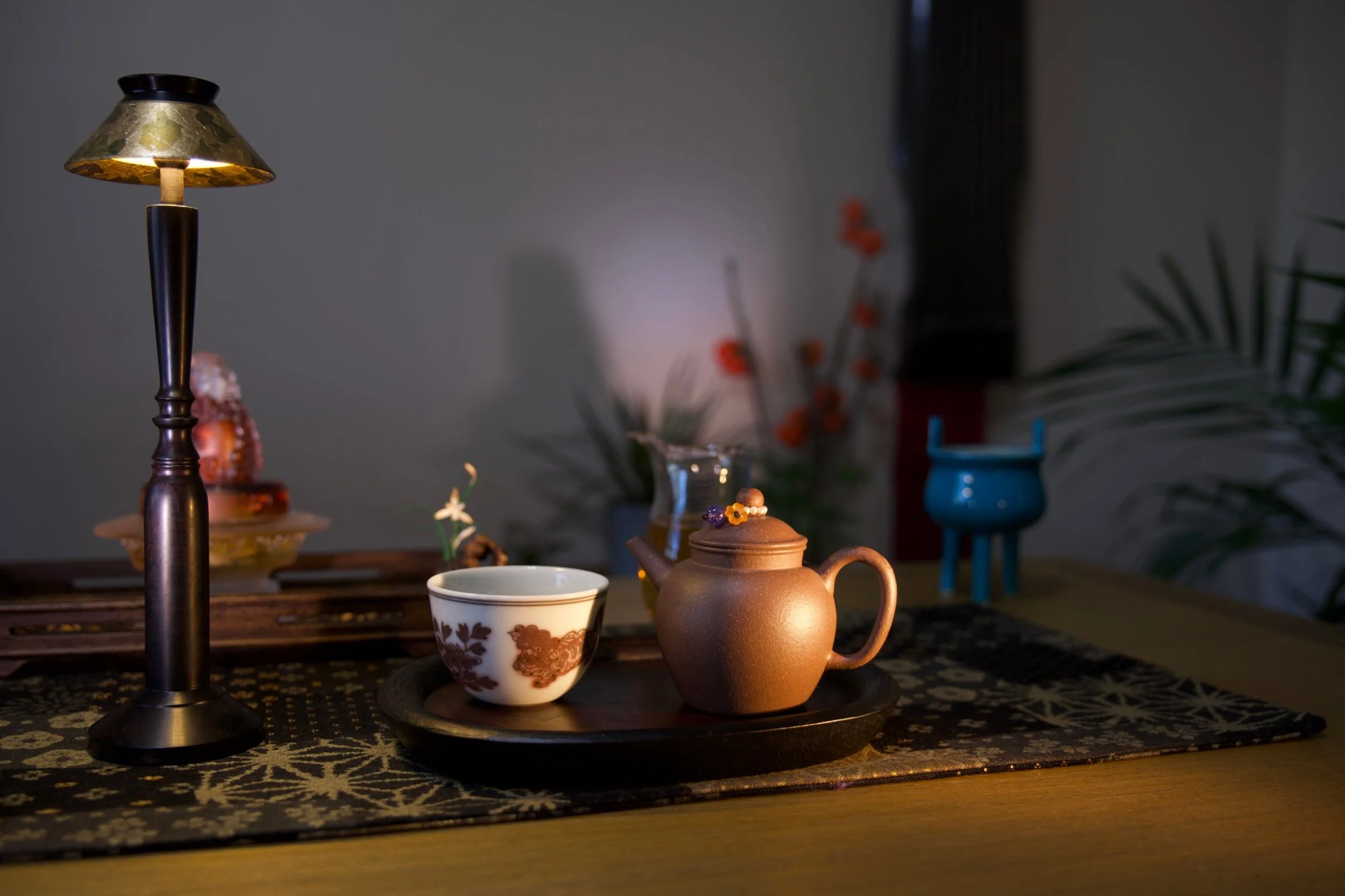
A compact, rounded teapot, handmade from purple-brown zisha clay, with a stepped domed lid, short straight spout and generous loop handle. The clay has a fine, sandy texture that develops a soft sheen with use.
An ideal size for gongfu-style brewing of oolong and pu-erh.
The bead charm shown on the lid is a styling prop and is not included, but a similar charm can be made to order on request for an additional fee. Please contact us for details.
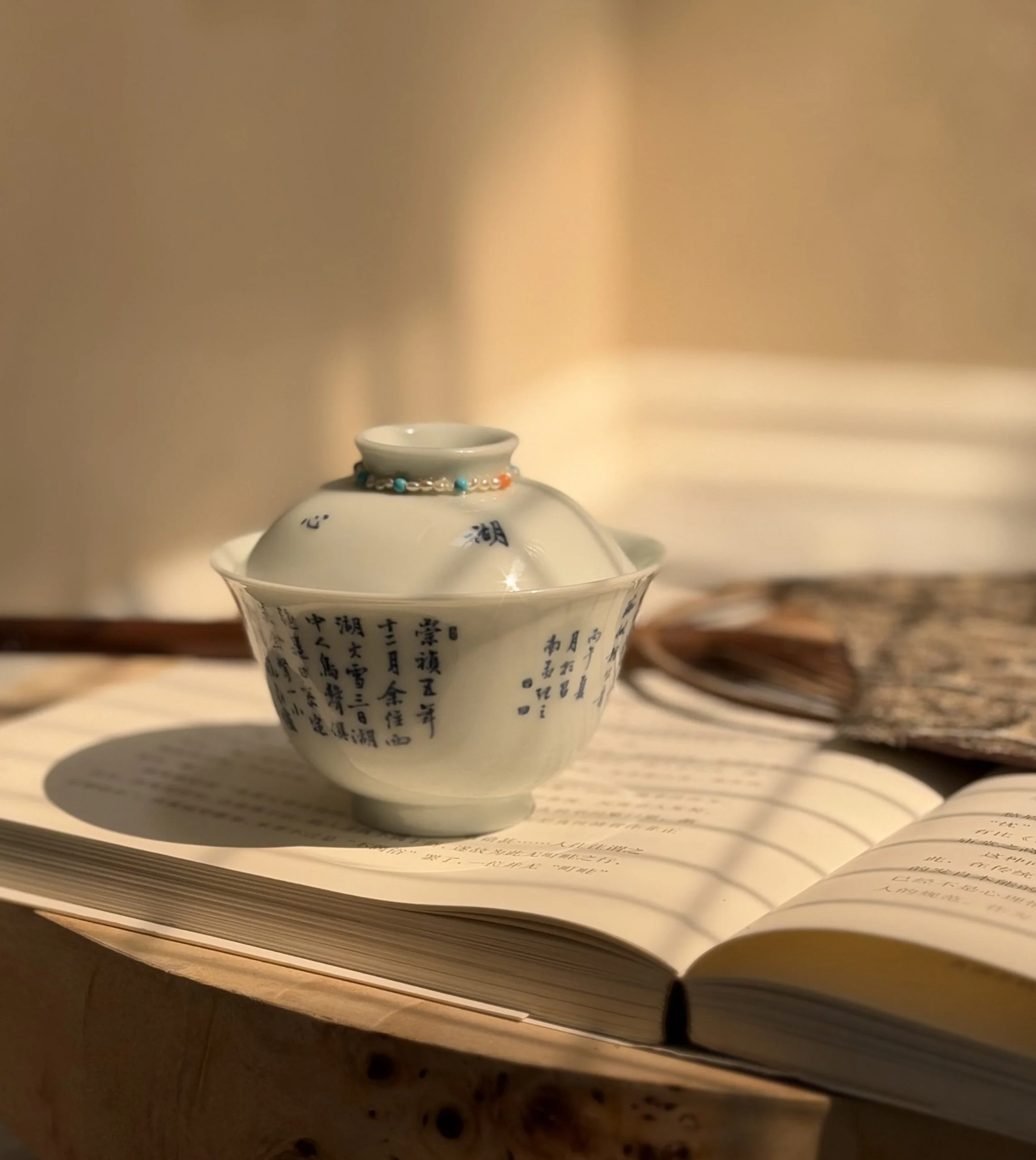
This handwritten blue-and-white porcelain gaiwan carries the text of The Lake Pavilion in Snow (湖心亭看雪), one of the most beloved essays in Chinese literature, written by the late-Ming scholar Zhang Dai.
The essay describes a quiet midnight journey. After three days of heavy snow, every sound has vanished from West Lake. Zhang Dai takes a small boat out alone to the pavilion in the middle of the lake to gaze on a world wrapped entirely in white, where sky, clouds, mountains and water all melt into one pale, endless white.
The Story Behind This Gaiwan
Zhang Dai was a celebrated writer of the late Ming dynasty, born into a wealthy, cultivated aristocratic family. He was famously a master of refined pleasures, endlessly curious and passionate about every beautiful thing life could offer.
He was an extraordinary tea connoisseur. He could taste a cup of tea and tell what kind it was, whether it had been picked in spring or autumn, and even which spring water had been used to brew it. Once, a famous tea master tried to trick him with disguised tea and water; Zhang Dai tasted it and uncovered every secret, astonishing the old master. He discovered a hidden natural spring and created his own tea, Lanxue (Orchid Snow) Tea. His servants never dared fool him with substitute water, because he would know immediately.
He kept a private troupe of twelve opera performers and loved staging performances in magical settings, even on snowy nights, letting song and music drift through the falling snowflakes. He was such a strict and insightful critic that performers grew nervous playing before him, and he would attend midnight shows in old temples under the moon, completely absorbed in the art.
He was also a gourmet. Every autumn he hosted elaborate crab feasts with friends, pairing fresh crab with fine cured duck, homemade milk custard and the finest tea. He collected rare antiques, built exquisite gardens, chased beautiful lanterns and fireworks, and hunted for rare flowers and birds.
Then, in 1644, the Ming dynasty collapsed. When a resistance rose to restore it, Zhang Dai sold nearly all his family property to recruit soldiers and fund the fight, pouring everything he owned into the cause. The restoration failed. He lost his land, his homes and his treasures, and fled deep into the mountains, where he lived in extreme poverty, often without enough to eat. Even so, he refused to submit to the new rule.
This dramatic change shaped his writing. Though The Lake Pavilion in Snow is set in the fifth year of the Chongzhen reign (1632), Zhang Dai wrote it years after the empire fell, and he still marked the memory with the old Ming reign year, a quiet tribute to his lost homeland. The snow remained unchanged, yet the man who looked at it was no longer the same. The contrast between his extravagant youth and his lonely, impoverished later years (the man who once chased every earthly delight, and then gave all he had for his country) gives the essay its deep, quiet melancholy.
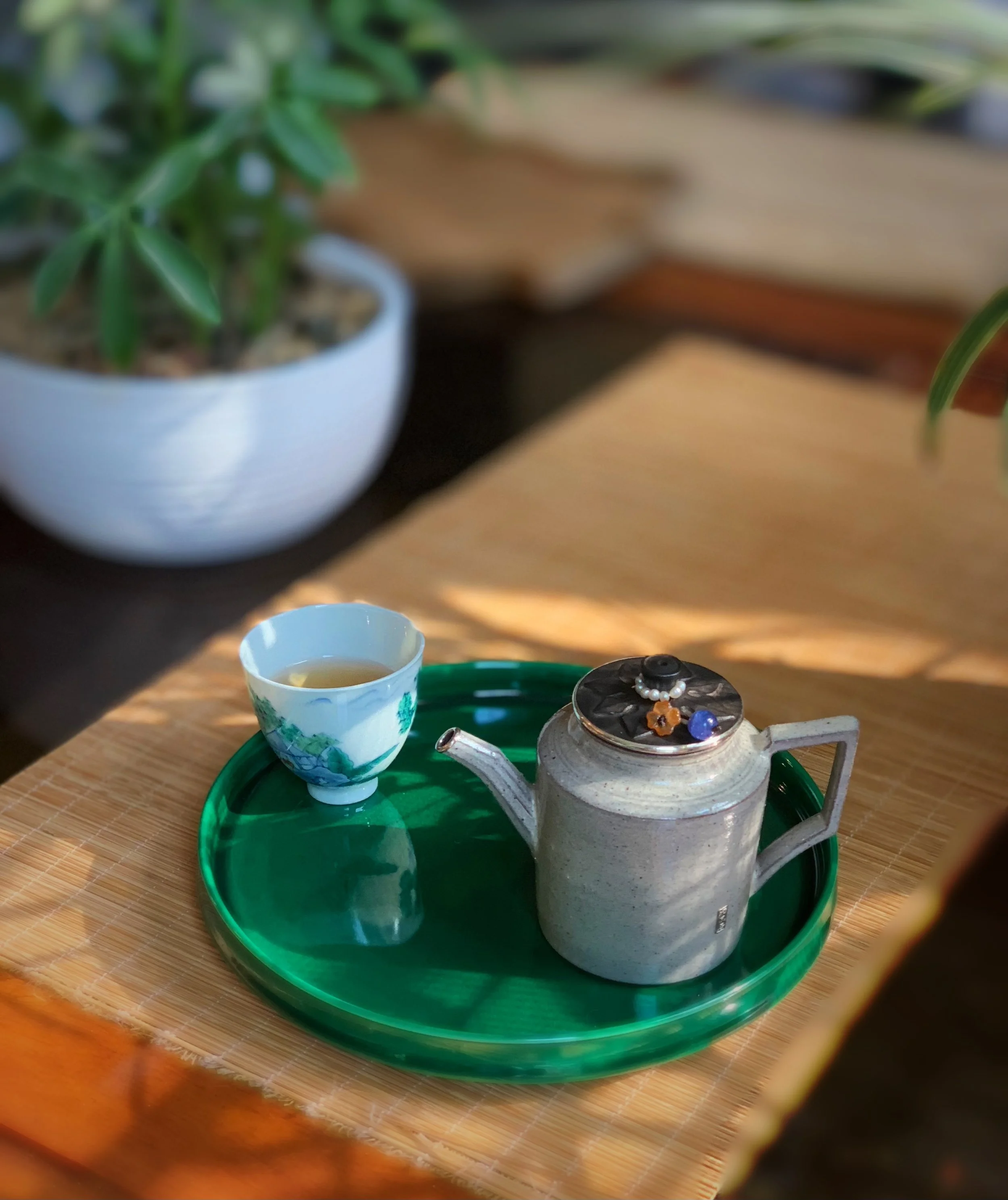
Craftsmanship. Made in Jingdezhen, each small regular-script character is brushed by hand onto the raw porcelain before glazing and high-temperature firing. The cobalt-blue calligraphy is sealed permanently beneath the glaze and will never wear away, no matter how many years of tea it brews. No painted landscape crowds the surface; the writing itself is the ornament, turning the gaiwan into a handheld page from an old book. The lid carries the characters 湖心 ("heart of the lake"), and its knob is dressed with a delicate strand of small pearls and turquoise-blue and coral-orange beads.
For brewing. Shaped as a classic ingot-style gaiwan, its thin, smooth white body holds heat gently, and the flared rim gives a clean, swift pour. It is especially well suited to ripe pu'er, aged white tea, oolong and black tea.
More than a brewing vessel, this is a literati art object for your tea table. When you pour from it, you hold not only poetry, but a fragile, private remembrance of a vanished age.
许是这几日在读张岱的《陶庵梦忆》昨日梦里竟也看了一场湖心亭的雪~
“雾凇沆砀,天与云、与山、与水,上下一白。湖上影子,惟长堤一痕、湖心亭一点、与余舟一芥、舟中人两三粒而已”
宗子先生少年时见雪 要携银瓶煮蟹眼~教十二梨园笙歌裹着雪片飞~而甲申后再看雪 雪还是那雪 亭还是那亭~只是举杯强饮那三大白时~杯中却是晃着的两个月亮——一个照故国 一个 照寒洲……
我闭目~湖、亭、皆成眼底一白~耳边隐隐有舟子喃喃~莫道相公痴 更有痴似相公者……
既然梦里同淋了那场崇祯五年的雪
那此刻~宗子先生您便算是我提前白了头的故人吧~
Tea, Ink and Stillness
Every teapot, cup, tea and painting in our collection is chosen by hand for its craft and character. These are objects made to be used, enjoyed and passed on, bringing a quiet moment of beauty to the everyday.